
Our research philosophy
A single idea can change cancer forever.
Progress is born out of thinking boldly, doing things differently, taking chances. This is how we give Canadians hope for a life that is bigger than cancer.
We have a rich legacy of supporting discoveries that have improved how we prevent, diagnose, treat and live with and beyond cancer. Because of research advances, 63% of Canadians diagnosed with cancer are expected to survive 5 years or more compared to only 25% in the 1940s.
But we’re just at the tip of the iceberg. To achieve improved outcomes for the nearly half of Canadians who will be diagnosed with cancer in their lifetime, we must accelerate change. We must invest in innovation. We must be forward-thinking.
Cancer isn’t a single disease with a single cause. It’s more than 100 different, shape-shifting diseases. There isn’t one target. There are multiple moving targets.
That’s why we fund research across the cancer experience and across all cancer types. It’s why we invest in grants focused on innovation and impact, prevention, survivorship and translating knowledge to action. It’s why we support junior investigators, multidisciplinary teams and leaders in their fields. We can’t afford to be narrowly focused. There’s simply too much at stake.
With your help, we will continue to strengthen and expand research potential through bold new ideas and emerging technologies. We will continue to build capacity across the country and bring researchers together by fostering partnerships and collaborations. We will continue to learn from the experiences of people affected by cancer. Above all else, we will continue to accelerate research to effect change nationwide, for all Canadians, in all communities.
Together we can ensure research transforms the future of cancer.
How we select the best research
Your donations allow us to support outstanding cancer research across Canada.
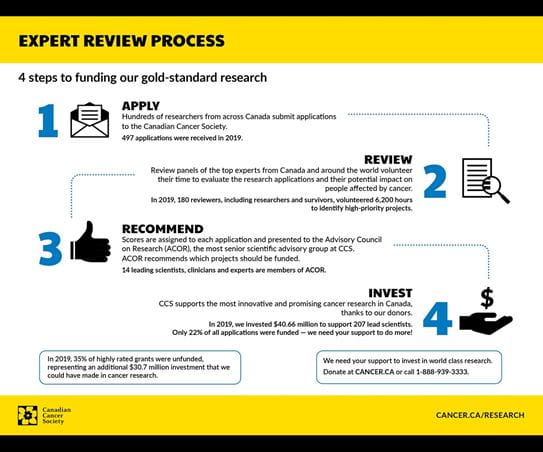
To select the most promising projects with the greatest potential for impact, we use a peer review process that relies on the expertise of leading cancer researchers from Canada and abroad. In the first step of this process, researchers submit funding applications that describe their projects and the potential they have to transform the status quo through prevention, earlier detection, improved treatments and access to high quality accessible care. Each application is then reviewed by a panel of experts with in-depth knowledge of the field and then presented to our Advisory Council on Research for funding recommendations.
Every year, we receive hundreds of applications from researchers across the country but are only able to fund a portion of these. This means that many high-quality projects and their potentially life-saving ideas don’t receive funding.
Help us do more. Donate today to accelerate research advances and change the future of cancer.
Help fund world-leading cancer research
With almost half of all Canadians expected to face a cancer diagnosis in their lifetime, the urgency for funding is at an all-time high. Research holds the key to transforming the future of cancer.
If everyone reading this joins our monthly donor community today, we can keep up the momentum for life-changing discoveries to better detect, diagnose and treat all types of cancer.
Please donate today because every contribution counts.